
FreeRangeClub.com

By Catharine L. Kaufman (a.k.a. The Kitchen Shrink)

It’s a seed! It’s a protein! It’s SUPERFOOD!

Picture 5 300x182 Quinoa—An Ancient “Staff Of Life”Imagine unpacking and listing the nutritional contents of a plant consisting of edible leaves and clusters of seeds commonly mistaken for grain—and finding that the latter contains practically the entire gamut of food components needed to keep a human being well nourished. In addition to its carbohydrate starches and abundant protein composed of a balanced set of essential amino acids, quinoa (pronounced keenwa) also packs a treasure-trove of dietary fiber, thiamine (vit. B1), riboflavin (vit. B2), vitamin B6, folate (vit. B9), iron, magnesium, phosphorus, zinc, calcium and more. What’s more, it is gluten-free and easy to digest.

No wonder quinoa is being considered by NASA’s Controlled Ecological Life Support System as the crop to take along on future space explorations of long durations, flown by humans.

 Origins: Pre-Columbian Andean hunter-gatherers who lived in the region now occupied by Columbia, Ecuador, Bolivia and Peru, must have been aware of the plant’s versatility and life-sustaining power, for quinoa became a mainstay of their diet. Archeological finds dated the use of wild quinoa back about 5,200-7,000 years—although domesticated strains only appeared some 3-4,000 years ago.

When the Incas declared quinoa sacred and included it in religious rituals—expanding its value as a food source to social and spiritual importance—the plant’s fate was sealed, at least for the duration of Spanish conquest and colonization, when the cultivation of this ‘non-Christian’ crop was banned and the Picture 3 300x249 Quinoa—An Ancient “Staff Of Life”region’s indigent population was forced to grow wheat and later maize (corn) instead of quinoa.

Although quinoa never regained its dominant place in the region’s agriculture—and even when it did make a comeback, of the more than 120 species once known to Andean civilizations, only three went back into contemporary cultivation. Most popular of the three strains—because of its similarity in flavor and consistency to rice—is the cream-colored quinoa seed, which is sold in supermarkets everywhere. The red and more rare black varieties can be found mostly in specialty food stores.

Since this clever plant protects its precious seeds from birds and bugs with a coating of bitter-tasting saponins, it requires no chemical protection while under cultivation—although it does require some processing after it is harvested, to eliminate the saponins. Most quinoa sold in North America has been processed to remove its bitter coating, saving consumers the bother to do it themselves.

Hot, Cold, Savory, Sweet—Anything Goes in Quinoa Preparation: Liberate your culinary creativity and find as many uses for this versatile and nutritious delicacy as your imagination allows. Picture 2 300x228 Quinoa—An Ancient “Staff Of Life”Cook up a batch in water (see package instructions) or toast at low heat on stovetop with olive oil for a nutty taste (adding chopped onion and/or garlic for a super pilaf). Either way, you’ll notice a tiny, thread-thin ‘tail’ curling away from each crunchy seed, but combining in the mouth for a delightful flavor—which makes some people think of miniature rice grains.

Be daring—quinoa may look delicate, but it keeps its texture and look when cooked. Use confidently in salads. Serve as a side dish with stews or stir-fries. Combine with ground meat for turkey burgers or meatloaves—or pair with legumes and veggies for vegetarian/vegan burgers. Get fancy by tracking down all three quinoa strains—cream colored, red and black—and create a tri-color hot or cold dish for your dinner guests. Boil quinoa in apple or orange juice and add fresh or dried fruit and cinnamon for a just-sweet-enough breakfast cereal or desert ‘pudding.’ Whip up muffins, breads, cookies, scones or pancakes with quinoa flour. Or do all or any of the above when quinoa-lust strikes. You may even go raw by sprouting the quinoa seeds and topping your sandwiches with the green shoots. Nor should you pass up the quinoa plant’s nutrient-rich green leaves, which can be tossed with salad greens, steamed like spinach or sautéed with olive oil and garlic.

The following divine Tabouli Quinoa Salad recipe, recently added to the menu of San Diego’s Sammy’s Woodfired Pizza restaurant, was generously Picture 41 300x211 Quinoa—An Ancient “Staff Of Life”shared with me by its creator, Executive Chef Jeff Moogk:

Tabouli Quinoa Salad

½ cup of shredded carrot
2 cups chopped parsley
1 cup chopped mint
1 cup diced onion
1 cup diced fresh tomato
1 cup diced cucumber
2 cups shredded lettuce
1 cup cooked quinoa
½ cup extra virgin olive oil
½ cup fresh-squeezed lemon juice
2 tsp salt (optional)
2 tsp ground black pepper
1 tsp ground allspice

Cook quinoa according to package directions—and cool. Combine all ingredients and mix well. Serve over a bed of Romaine leaves. Serves 6—8 persons at lunch or dinner.

By Dina Eliash Robinson

Fair disclosure: Some dozen years ago, spooked by too much information about our food supply, Lewis and I switched to buying and eating organic foods, grown locally or within the closest possible proximity. (The latter assured maximum freshness and nutritional content, as well as minimum energy use—i.e., carbon footprint—in transportation.) Still, skeptics to the bone, we remain vigilant in locating Certified Organic signs reading labels with attention to both content and omissions and grilling grocery store staff about their fresh produce. We have also learned to switch off all concerns about toxic agricultural Picture 55 Who’s Afraid Of Food Labels? chemicals, hormones and genetically altered foods on the rare occasions we eat out, in order to enjoy our meals. Happily, now that more restaurants and dinner party hosts are serving organic foods, our “off” switch is getting less of a workout these days.

But since most consumers are either too busy or uninterested in learning more about the safety and nutritional value of their groceries, there is an urgent need for government mandated food labeling that requires the listing of all ingredients and known nutritional information on packaging, in clear, accurate and legible ways.

Unfortunately, the Environmental Protection Agency (EPA) and the Food and Drug Administration (FDA) seem to have taken a pass on their responsibility Picture 4 Who’s Afraid Of Food Labels? to protect the public from toxic foods and our environment from the devastating effects of agricultural chemicals, factory farming and genetically engineered grains and other so called Frankenfoods. In fact, these agencies continue to stonewall all attempts by scientists and consumer groups to implement and enforce complete and accurate labeling that could, at least, enable people to make more health- and nutrition-savvy choices when shopping for food.

Not surprisingly—and reminiscent of the tobacco companies’ long, costly but fortunately futile resistance to the mandated labeling of cigarette packages with health warnings—the chemical and bio-genetic grain producers such as Monsanto, Dupont and Dow have been fiercely resisting the disclosure of GMO (genetically modified organisms) and GE (genetically engineered) ingredients on food labels. They argue that listing them would cut into their sales by arousing consumers’ suspicion that there might be something wrong with such products. Proponents of accurate labeling—such as the Organic Consumers Association and other environmental and farming groups—are hoping that should, indeed, accurate labeling influence shoppers’ grocery buying patterns, this might provide an incentive for the industry to produce fewer processed and more wholesome and toxin-free foods. We can only hope…

In the meantime, the Union of Concerned Scientists, physicians at the American Academy of Environmental Medicine and others have been finding cause-effect connections between the consumption of genetically engineered foods and auto-immune disorders, liver and kidney damage, nutritional depletion, allergies, infertility, birth defects and even autism and premature aging in certain cases. This is not surprising, given the fact that 75-80 percent of all processed foods sold in the U.S., contain GMO products. According to the OCA, they are also present in “almost all non-organic foods containing soy or Picture 61 150x150 Who’s Afraid Of Food Labels? canola oil, corn, sweeteners, artificial and natural flavorings…”

Here are some of the more pressing health and environmental concerns that have emerged from various scientific studies in recent years—concerns that the EPA and FDA are strangely silent about:

• Monsanto’s engineered genes have been found in the bloodstream of pregnant women, their fetuses and many babies born in the U.S. Also reported as present in these studies by the journal of Reproductive Toxicology were such pesticides associated with GE foods as Bt toxin, glyphosate and gluphosinate.

• According to Salk Institute biologist Dr. David Schubert, children are at the greatest risk to be adversely affected by toxins and dietary problems caused by genetically modified foods. Since no one knows the long-term effects of the latter, kids are in effect the experimental “lab rats.”

• Enormous (and increasing) amounts of pesticides are required in the cultivation of GMO and GE crops. Among these chemicals are Monsanto’s RoundUp, a glyphosate considered to be more harmful than DDT; Dow’s Dioxin-tainted 2,4-D; Bayer’s Imidacloprid, which is implicated in the collapse of bee colonies, and others.

• These pesticides are known to deplete and pollute the soil and poison water sources.

• More than 50 countries around the world—including Japan, Russia, Hong Kong as well as China (including Hong Kong), South Korea, France and Australia—have either banned GMO and GE products altogether, or passed mandatory labeling laws.


Hope this information helps you make good choices when shopping for your groceries.


17 Jul, 2012

More Food Tips (Part II)

Posted by: Catharine Kaufman In: Food Safety|Food Tips|Kitchen Shrink Columns

By Catharine L. Kaufman—a.k.a. The Kitchen Shrink

 Hello again, fellow foodies!

Here is the second batch of 10 tried and true food handling, storing and cooking tips for your collection. Some of these I stumbled upon by accident or trial and error while searching for help to prevent or repair culinary glitches. The rest were gathered from other food-impassioned solution seekers and, of course, thoroughly tested in my kitchen before being added to this list. .

1)    Soup Rescues:

DSCF0009 150x150 More Food Tips (Part II)(a)   Remove Excess Fat by floating a crisp lettuce leaf on top of your cooling soup for a few seconds and scooping it out carefully. The lettuce acts like a fat-magnet. Use more than one leaf if necessary.

(b)   Thicken Soup by boiling it up for a minute with a handful of fast-cooking pasta (small alphabet or skinny angel hair noodles), or sprinkle some potato flakes on it and simmer for a few seconds. Adding cooked rice or croutons to the bowl when serving, also gives body to the soup.

(c)   Enrich the Flavor by adding the herbs and spices to your soup during the last five minutes of the cooking process.

2)    Lemon Squeeze:  To get the most juice out of a lemon, keep it at room temperature for a day (or immerse it into a bowl of hot water for a few minutes), then, with your palm, roll it on a hard surface back and forth until the rind feels supple and the lemon softer. Important Tip: After you have squeezed the last drop, plastic-wrap tightly the remaining pulp and rind and store it in your freezer to use later for cake batters, DSCF00212 150x150 More Food Tips (Part II)risottos, stews or other dishes.

3)    Flour Protection:  To prevent bugs from taking up residence in your flour, store it in a wide-mouth glass jar and add a bay leaf to keep pests away. Or store it in a freezer-safe Pyrex container in your freezer to make sure that if any stray (pinhead-size) moth eggs managed to sneak through the grain milling process, they can never hatch.

4)    Slick Your Noodles:  To keep pasta from sticking together, add a couple of tablespoons of olive oil to the boiling water before immersing the noodles. Strain when done and gently fold another tablespoon or two of olive oil (per package) into the finished pasta. Useful Tip: Undercook by a few minutes (based on package directions) any pasta you intend to bake or cook further—such as lasagna, ziti prepared as a casserole, stuffed shells, etc.

5)    Keep Berries Free Of Mold:  Rinse only the amount you plan to eat or serve right away. If, however, you intend to keep berries in the refrigerator for Picture 9 300x104 More Food Tips (Part II)a few days, give them a quick rinse first in a weak dilution of water and apple-cider vinegar, drain in a sieve and air-dry in a cool place for an hour or so, then refrigerate in an open bowl.

6)    Apples Won’t Turn Brown when squirted with lemon juice before storing.

7)    Mushrooms Are Best Stored in a paper (not plastic) bag—but should be cooked (or eaten raw) within a day,DSCF00122 150x150 More Food Tips (Part II) since they go bad very quickly. Useful Tip: Brush off dirt with a soft brush, cut off stem bottoms, give mushrooms a quick cold water rinse in a colander and drain well before either cooking the fungi or serving raw edibles in salads.

8)    Potato-Wise: Keep potatoes in a cool, dark place until ready to be cooked. Potatoes tend to rot faster when onions are stored nearby. Use potatoes before they get a chance to germinate. Scrub them with a brush and rinse with cold water. Examine the spuds carefully and gouge and discard each sprouted ‘eye’ before cooking. (Sprouting tendrils contain a mild toxin the plant creates to protect its offspring.) Cook potatoes with their nutritious and edible skin. This versatile root can be prepared in many ways—from mashed with yogurt, cooked spinach or broccoli; to baked or roasted after being sliced in the shape of coins or French fries and tossed to be well-coated in a mixture of olive oil, balsamic vinegar, herbs and spices.

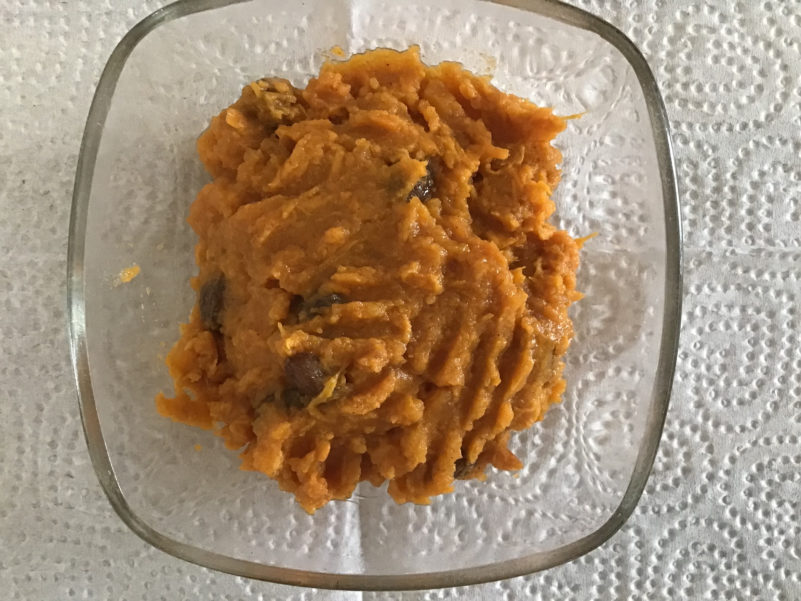
9)    Yummy Ruby Yams:  As with potatoes, store yams in cool, dark place, scrub and rinse, discard sprouting ‘eyes,’ slice, coat with olive oil mixture as above and bake or roast for a savory side dish. Surprise Tip: Yams also make glorious desserts. A quick and easy one includes cutting the tuber into big chunks; boiling in water until soft; peeling and mashing; adding vanilla and cinnamon to taste (and proportional to quantity); sprinkling a handful of plumped up raisins or dried cranberries; and carefully folding in whipped cream (optional). For a grownup party version, add a dash of dark rum, Grand Marnier or other liqueur.

DSCF00191 150x150 More Food Tips (Part II)10)   In A Nutshell:  Since nuts and seeds have a high fat content and tend to go rancid rather quickly, store them in tightly closed glass containers in the fridge or freezer to keep light and moisture out. They generally last four months in the refrigerator and eight months in the freezer with their texture intact. Nuts and seeds tend to pick up the taste and odor of nearby foods, so it’s best to keep them in solitary confinement. Taste before use because a few rancid pieces can ruin a whole dish. Delicious Tips: Toss and bag nuts, seeds and dried fruit into a healthy, energy-boosting Trail Mix and add to kids’ lunch boxes or a picnic basket. Also, various combinations of the Mix make great additions to stir-fries, ice cream toppings, cereals and more. Here is my favorite recipe for a Sweet and Savory Toasted Nuts combo:

1 cup assorted shelled nuts (walnuts, almonds, cashews, etc.)

¼ teaspoon sea salt

¼ teaspoon cinnamon

a shake or two cayenne pepper (to taste)

¼ teaspoon powdered cumin

a dash nutmeg

¼ cup brown sugar

2 tablespoons butter (for low-cholesterol version use walnut, almond, sesame or sunflower oil)

1 teaspoon Worcestershire sauce

In a mixing bowl, combine salt and spices and set aside. In a skillet melt butter or heat oil on medium, add nuts and toast. Add remaining ingredients and a teaspoon of water. Cook on low heat until sugar is melted. Spread the combination on parchment-lined cookie sheet and cool. Store in airtight containers.


20 May, 2012

Save Water, Health & Time

Posted by: Dina Eliash Robinson In: Food Safety|Public Safety

By Dina Eliash Robinson

Water—clean, uncontaminated and fit to drink—is the world’s most precious, and increasingly scarce commodity. As the planet heats up and its population grows, we’re in danger of running out of this resource, upon which depends the survival of our entire ecosystem. To prevent us from sliding into a bleak “Mad Max” world, we must become super-smart in water use and conservation.

With the following Smart Water Management Tips, the Free Range Club is kicking off a friendly competition of ideas and practices that could help improve the ways we treat, recycle and purify H2O in our households, industries and public utilities. Top three winners of this competition will be rewarded with copies of our own Kitchen Shrink’s (a.k.a. Catharine Kaufman) latest (and delightfully illustrated), children’s book, featured on this site: “Joleen – The Adventures of a Junkfood Queen.”dscf00242 150x150 Save Water, Health & Time

• Buy Only Produce You Plan to Use Soon:
(1) Fruits and vegetables depend on, and consist mostly of water. The faster they get from farm to stove, oven or fridge, the more of their nutritional value, flavors and textures will be available for our consumption.

(2) Plan your meals around the fresh produce you buy that day.

(3) Buy only what, and as much as you have time to clean, cook, prepare or store within the next 24-36 hours.

(4) Shop for fresh produce just before your frozen foods and perishable fresh meats, fish and other seafood. And don’t leave these in the car while you run other errands.

(5) Do NOT store fresh-from-the-store eggs before you wash them.

• Water-Miser Produce Cleaning:
(1) At home, put the bags of leafy vegetables in the fridge temporarily, so they won’t wilt while you wash the rest of the produce.

(2) Put any berries you bought on the top shelf of your fridge. Berries are the only produce that should not be pre-washed. When you want some, take out only the amounts you plan to eat right away; dunk them into a small bowl of water with a squirt of liquid Eucalyptus Pure Castile soap; gently swish them around with your fingers; pour it all into a small colander or sieve and rinse well under the faucet with a moderate spray (if you have the sprinkle setting on your faucet) of cold water. Berries are now ready to eat—on their own, or in cereals, yogurt, etc.

(3) For grapes and cherry tomatoes, fill the appropriate size bowl with cold water; add a generous squirt of liquid Eucalyptus Pure Castile soap; add grapes and cherry tomatoes; wash gently with your hands; transfer to another bowl with clean cold water and rinse well; repeat this, then put grapes and cherry tomatoes into a colander and rinse well again under cold water, using the sprinkle setting. Next, stand the colander on a rack or plate where the water can drain and let the produce drip and dry till morning. Dry remaining water by dabbing gently with dish- or paper towel; transfer grapes into one bowl, tomatoes into another and refrigerate, so you can just reach for a handful when you want it. They keep well for a week or more.

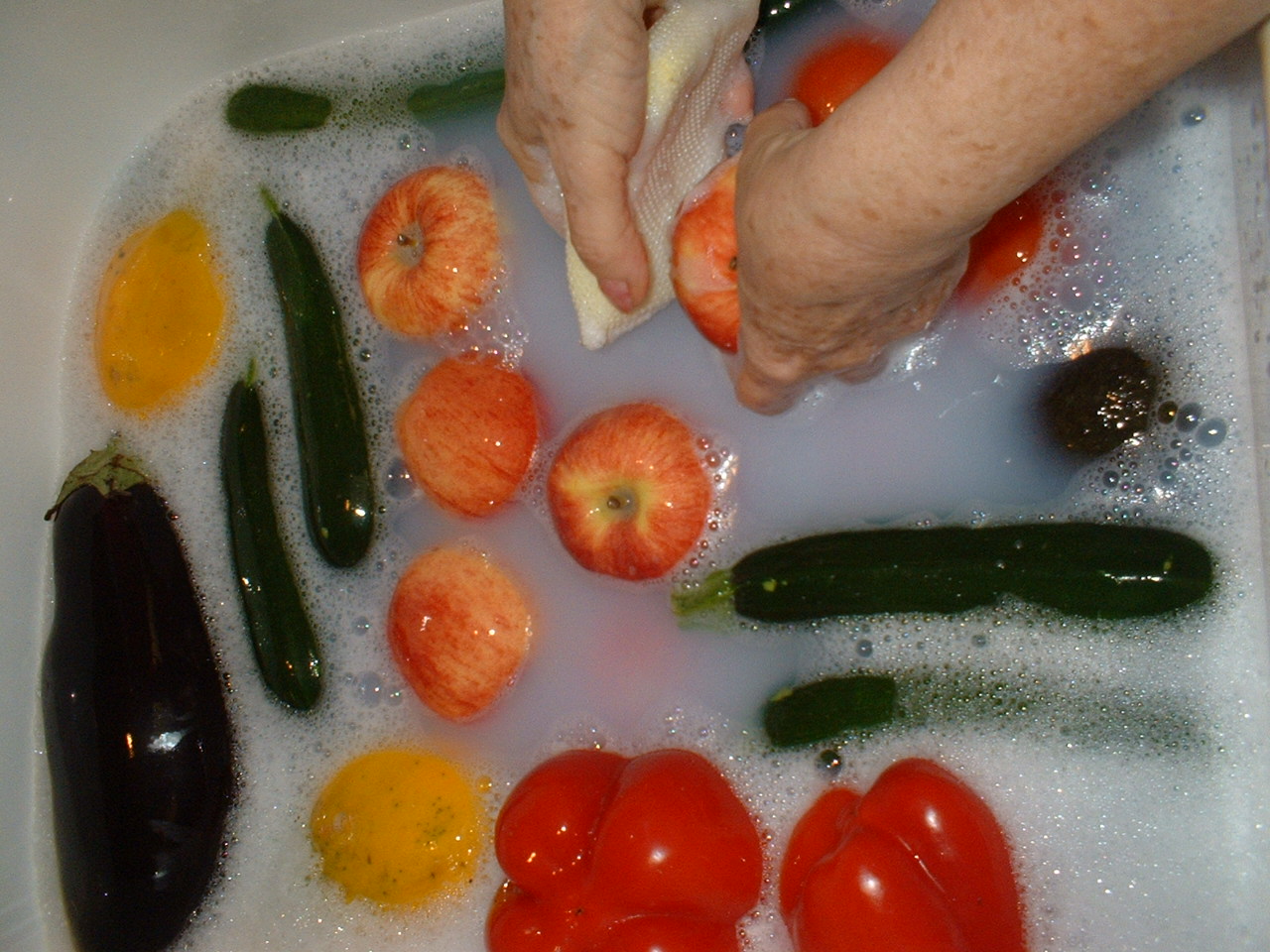
(4) Put all your fruits and non-leafy veggies that have skin (but NOT the berries, grapes or cherry tomatoes) into a clean sink. Fill it with enough cold water to cover them; turn off the faucet; add ¼ cup of liquid Eucalyptus Pure Castile soap; and using a clean sponge—preferably a Dobie pad—scrub separately each fruit and veggie, applying more pressure to those with tough skins (bananas, apples, oranges, avocadoes, potatoes, etc.) and less to delicate ones (tomatoes, zucchini, etc.).
Note: Be careful not to break their skins—but if you do, rinse those off right after scrubbing, dry with dish- or paper-towel, put them on a plate and store in the fridge, to be used before the rest.

dscf0005 150x150 Save Water, Health & Time

dscf0003 150x150 Save Water, Health & Time(5) Next, let the water out of the sink and rinse well both sink and produce with a cold spray from the faucet. (Castile soap rinses off very easily, leaving the produce squeaky clean, with no soapy residue.) dscf0007 300x225 Save Water, Health & Time

Place the produce into an empty dish-rack or big colander to dry overnight. If it’s not completely dry by the morning, wipe with dish- or paper towel, store bananas in a paper-towel-lined basket or on a banana rack; leave unripe produce (avocadoes, oranges, etc.) in a colander or bowl, away from heat until ripe enough to be refrigerated; and store ready-to-eat fruit, tomatoes and salad veggies in your refrigerator’s produce drawer. This way they’ll keep for two or more weeks and are always ready to eat when you reach for them.

(6) Repeat the above process with the leafy veggies (lettuce, kale, chard, spinach, etc.), rinsing the leaves in small batches under the faucet if necessary. If you have a salad spinner, use it for your salad greens, then store them in clean plastic bags on the top (least cold) shelf of your refrigerator. Put leafy cooking veggies into a colander to let most of the water drip down—but make sure you cook them within an hour after they’re washed.

Advantages of above system are that it protects health and saves both water and time. It’s easy to check the following B & C. Health effects (A) take longer to show.
(A) Putting only clean produce into your refrigerator protects your and your family’s health from bacteria and, if any of the produce is not organic, from pesticide residues which can also transfer to other foods.
(B) It saves water. You may not realize it, but if you take an unwashed fruit out of the fridge, you’ll run more water to wash it than you would use on a batch of produce. Plus, people in a hurry do a poor job of washing whatever they grab out of the refrigerator on the fly.
(C) It takes much more time to wash individual produce items than taking care of this chore all at once.

A Point Worth Dwelling On: Far more valuable than diamonds and gold, H2O is the main component of living organisms—our bodies included—and thus the source of all nourishment and breathable air. More wars, economic stresses, political shenanigans and health crises have been triggered throughout history by the need to have, protect and control water than any other resource. Even wild animals that often go hungry to avoid danger, will brave it when thirsty by joining predators for a drink. The need for water is so well understood in the wild that predators and prey usually observe a truce while slacking their thirst at the same water hole.

Being smart about water also means to protect it from pollution and finding new technologies to remove agricultural, industrial and pharmaceutical toxins that continue to leach into our rivers, streams, oceans and groundwater. Any ideas?

Join the Smart Water Management Tips contest by e-mailing us your ideas at dina@freerangeclub.com

After decades of foot-dragging and inaction in the implementation of its own1977 rule to rescind approvals for the use of certain antibiotics in farm animals, it might be foolish to believe that the Food and Drug Administration would finally comply with the March 2012 order issued in New York by Federal Court Judge Theodore Katz to act on its long-ignored rule. Especially since it also managed to stonewall countless lawsuits initiated by consumer and health advocacy groups—such as the one led by the National Resources Defense Council last year—that have held the FDA’s feet to the fire without success.

While the FDA readily acknowledged that feeding farm animals low doses of certain antibiotics could produce dangerous, possibly lethal strains of highly infectious antibiotic-resistant bacteria that are easily transmitted to farmers, livestock, meat handlers, consumers, pets and other animals and humans whoPicture 31 Will FDA Comply With Court Order It Has Ignored For 35 Years? come in contact with carriers of these organisms, for the last 35 years, it has taken no action to prevent this calamity from happening. The FDA did put up a smokescreen in the form of an ‘order’ to ban non-medical use of penicillin and tetracycline in farm animals, but only contingent on the drug companies’ judgment on whether or not these antibiotics were safe to use for this purpose. In the meantime, the FDA ‘order’ or ‘rule’ was never enforced. Blame was pinned on resistance by Congress, lobbyists for factory farms (i.e. Big Agriculture) and of course, by pharmaceutical companies.

Solution: Be Proactive In Protecting Your Health
• Take matters into your own hands by becoming an educated consumer. (We’ll help start you off with our thoroughly researched and fact-checked information right here.  Ask us questions, correct our glitches and we’ll keep doing the work for you.)
• Stick with organic foods (locally grown when possible). You’ll avoid toxic chemicals, nutrition-poor produce grown in depleted soil and animal productslaced with hormones, antibiotics, pesticides, fungicides and other junk not meant for human consumption.
• Since stray livestock or other natural interference can—on thankfully rare occasions—contaminate even some carefully tended organic produce in theirfields, we advise meticulous cleaning of fruits and vegetables before eating, cooking or storing for future consumption. (Click onhttp://freerangeclub.com/food-safety/save-water-health-time/ for cleaning and storing tips.)
• Above all, good information eliminates fear and worry, empowers you to make smart food choices, keeps you healthy, improves your disposition and saves you money in sooo many ways… Plus, when enough of us vote with our $$$, good things happen in the food industry—as proven by the huge increase in the production and availability of organic foods.
DER

Update: New FDA Restrictions On Antibiotics Use For Farm Animals
April 11, 2012—As of this day, the Food and Drug Administration will permit agricultural use of antibiotics only by prescription from veterinarians. It is a somewhat stingy but still welcome concession made to public health, either as a result of last month’s court order to tighten controls over the use of these drugs for farm animals, or perhaps because of the public outcry over the growing—and often lethal—epidemic of infections caused by antibiotic-resistant superbugs. An epidemic which is estimated to sicken about two million people and kill nearly half of them every year.

Since some 80 percent of antibiotics sold in the United States are used to keep farm animals and poultry alive and growing while they are raised in Picture 43 Will FDA Comply With Court Order It Has Ignored For 35 Years?unhygienic and dangerously crowded conditions, the FDA’s new restrictions are sure to take a bite out of factory farms’ profits. Let’s hope there won’t be loopholes or detours devised around these rules to make up potential losses, although it might be too much to hope that veterinarian expenses won’t be used as excuse for increases in the price of animal products in grocery stores.

Appointed last year with a mandate to help protect the safety of U.S. food supplies, Michael R. Taylor, the FDA’s deputy commissioner for foods, predicts that since these restrictions will make access to antibiotics more costly, time consuming and complicated, they will save lives by “significantly” reducing the use of antibiotics in agriculture.

Our research shows, however, that even if Mr. Taylor’s prediction turns out as he expects (which, with all due respect, we seriously doubt), the epidemic of intractable infections caused by antibiotic resistant bacteria will continue until we stop consuming daily doses of antibiotics in our beef, pork, chicken and turkey meats.

The Dark Side Of Antibiotics: Few people know that in addition to being among the world’s most effective life-saving drugs, antibiotics also have a built-in flaw: They cannot tell the difference between bad (illness-causing) bacteria and the beneficial bacteria (or ‘friendly flora’) which lives in the human intestines and is essential to the health and function of both the immune and digestive systems. Because antibiotics cannot discriminate, they destroy both harmful and helpful bacteria they encounter. Healthy individuals. exposed to small but frequent doses of the drug through consumption of animal foods that have been treated with it, often have digestive problems and weakened immune systems that show up as fatigue and susceptibility to—you guessed it—infections caused by the superbugs.

When, on the other hand, an illness is treated with a course of doctor-prescribed antibiotics, both harmful and beneficial bacteria are killed, leaving the body depleted of recuperative resources and thus slowing or stalling recovery.

Prevention And Remedy: Fortunately, the first problem can be reversed by switching to organic meats (and/or fish) that have not been treated with antibiotics or changing to a vegetarian or vegan diet; while also taking good quality, dairy-free probiotic supplements daily (at least once a day, preferably first thing in the morning, on an empty stomach), to replenish and maintain a healthy level of friendly flora in the gut.

During illnesses that are being treated with antibiotics, probiotics should be taken one hour before each meal and the medication after or while finishing the meals. Including even small amounts of starchy carbohydrates in meals also helps friendly bacteria colonies take hold and grow faster.
When eating out, pick restaurants that serve organic meats—or choose vegetarian dishes. And don’t forget to make probiotic supplements your daily routine.
Dina Eliash Robinson

Catharine’s Book

Jolene loves junk food. She loves it so much she wears red licorice in her hair—and pink taffy underwear! The Munch Bunch calls her "The Junk Food Queen." Then, one night in her dreams, she meets a bunch of cool characters who take her on an incredible, edible journey into a world of juicy fruits, super salads and yummy smoothies.
Book acclaimed by The Diabetes Research Institute Foundation - which uses it in its fundraising drives.

Organics Controversy

FreeRangeClub Editor Corrects “Is It Organic?” Author’s Perception of Flaws in Organic Food Industry

Our Catharine “The Kitchen Shrink” Kaufman recently received the following comment from Mischa Popoff in Osoyoos BC Canada , under the heading of “The inside story of the organic industry.”

Mr. Popoff’s e-mail was forwarded to me for reply—mostly because researching all things pertaining to organic foods, from production to consumption, has been my task since FRC first hit the Web. Far from claiming expertise—the topic is too vast and changeable—I merely admit to passionate interest in factual information that leads to safe foods and healthy nutrition.

We decided to share this exchange to answer some questions and perhaps come up with new ones. Hope you won’t hesitate to chime—opinions, conclusions, different information are all welcome. Post your comments, corrections, critiques, messages and contributions to this discussion directly on this site or e-mail them to me at FreeRangeClub.

E-mail from Mr. Mischa Popoff to The Kitchen Shrink:

Dear Catharine,

To listen to some media outlets you’d think the multi-billion-dollar organic industry was infallible. I’m trusting you’ll be a bit more objective.

As you may already know, I worked for five years in the United States and Canada as an organic inspector. I believe fervently in the principles of organic farming but maintain that we have to prove those principles instead of operating on the politicized, bureaucratic honor system that’s been the organic industry’s mainstay for the last decade.

See remainder of Mr. Popoff's Email & Dina's Reply

Our International Friends

Bridging Two Continents
The Movable Festa Of Aroma Cucina

by Dina Eliash Robinson

Ciao Dina, Thanks so much for your interest in Aroma Cucina!. My wife, Jude, and I are honored to be part of the FreeRangeClub.com. Jeff

My discovery of the bi-continental Aroma Cucina while surfing the Internet for food sites and recipe ideas, turned out to be a case of mistaken identity—specifically, my mistake in thinking it was a restaurant. Not.

more

Archives

Sign up for our Email Newsletter

Subscribe to the FreeRangeClub to receive regular updates of our articles on the pleasures and benefits of eating for health and how to navigate our increasingly unsafe food supply!

We want to hear from you!

Your corrections, critiques, contributions of recipes and other information are welcomed and appreciated. Email Free Range Club!

Video Section

Mother’s Day Cooking Class By the Kitchen Shrink

Seeds at San Diego City College Wins Awards For It’s Urban Agriculture

Healthy Cookin with the Kitchen Shrink – Veggie Fried Rice

KIDS KORNERCOPIA VIDEOS

Catharine Kaufman, the Kitchen Shrink, appears in a series of five videos. In the first video she is seen interviewing Dr. Lisa Loegering, MD, a pediatrician, concerning children's eating habits. The other four videos take place in Catharine's kitchen, as she instructs her two daughters, and two of their friends, in the preparation of various dishes.

Children’s Eating Habits-Interview w/Pediatrician

Catharine and her Pizza Chefs

Making Baked Stuffed Apple

Fruit Sparklers and Feast

Make Your Own Salad

Jamie Oliver’s Food Revolution

English chef Jamie Oliver has come to the U.S. to start a revolution, to help save America's children from obesity and other food-related Illnesses. His successful efforts in the U.K. has resulted in improved school lunches in many communities there, as well as a total overhaul of the school dinner (lunch in the US) programs in that country. Following is a video of Jamie Oliver speaking before an audience at a TED conference.

A Video of Zoie (11) teaching us to make healthy sushi!

        Zoie (11 years old) is teaching us to make healthy sushi, with organic brown rice and organic avocado. Please click on healthy sushi to view the video.

Tender Greens Restaurant